Breaking Out of Old Patterns

If you’ve looked at most of my quilts on display here, you will have seen that I love free-motion quilting. I sincerely believe that the quilting design is just as important as the pieced and/or appliqued quilt top. While it does not need to be as ambitious as many of my quilt designs end up being, I would love to see all quilters stop and really think about how the overall quilting design can enhance the beautiful work they’ve created, whether they’re quilting it themselves or sending it to a professional longarmer.

I learned to free-motion quilt from taking a Craftsy.com class with Leah Day as well as watching tons of Angela Walters YouTube videos. They provided so much incredibly helpful information and inspiration, but over those first few years I found myself continuing to repeat quilting motifs and patterns I had picked up from them.

As I began creating my own quilt top designs, I realized I needed to start creating my own quilting designs as well, which I would do somewhat randomly, but I kept finding myself defaulting to the “oldies but goodies” that I had originally learned (so many swirls).

I was recently invited to join the Manhattan Quilters Guild which is such an honor. This small guild is made up of incredibly gifted quilt artists, and it has forced me to start rethinking my approach to quiltmaking. I’ve always had a bit of a loosey-goosey process, but if I really want to be taken seriously as an artist, I need to be more intentional from the beginning to the end of each quilt’s journey.

First step, sketch out ideas and just keep sketching. Work it out with paper and pen before actually sitting down at my sewing machine. (In the past, I would often just sit at my machine with a quilt sandwich under the needle as I stared and stared, trying to think of how I wanted to quilt each section.) When I’m sketching out ideas, I do it quickly and move on from each idea, reserving judgment until I’m finished with each session. The idea is not to come up with the perfect design on the first try but to just let my creative juices flow. Perfecting the idea can come later.

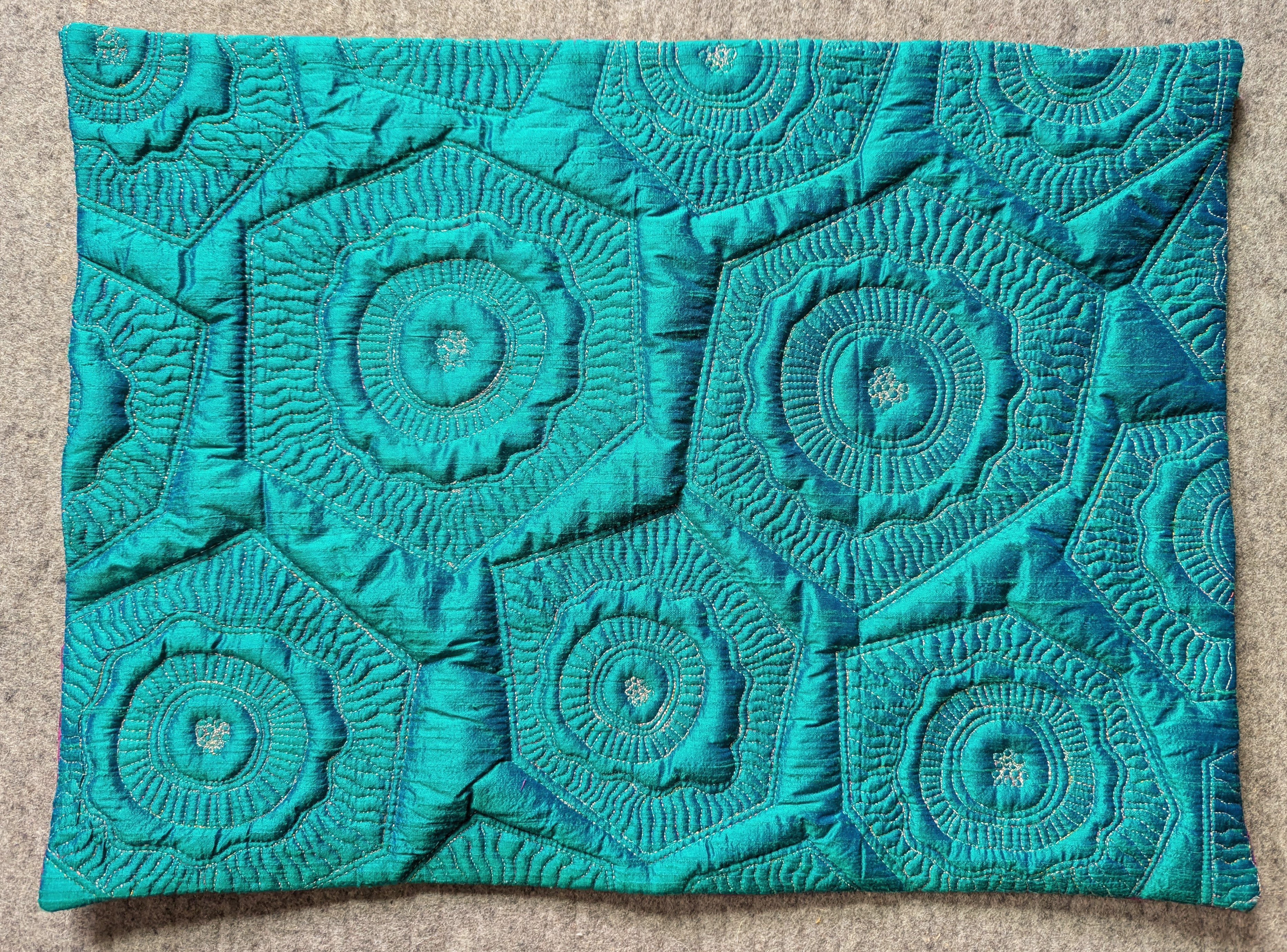
When I find some motifs that I really like, I begin practicing them with actual fabric. Sometimes I want to see how a single overall design motif would work, so I find a decent sized piece of scrap fabric, make a little quilt sandwich, and go to town. In the example below, I chose to practice a motif that involved constantly stopping, cutting thread, starting, stopping, cutting thread, etc. This is not how most free-motion quilting designs work, but I am intentionally trying to come up with completely original designs which means thinking outside of the standard FMQ parameters.

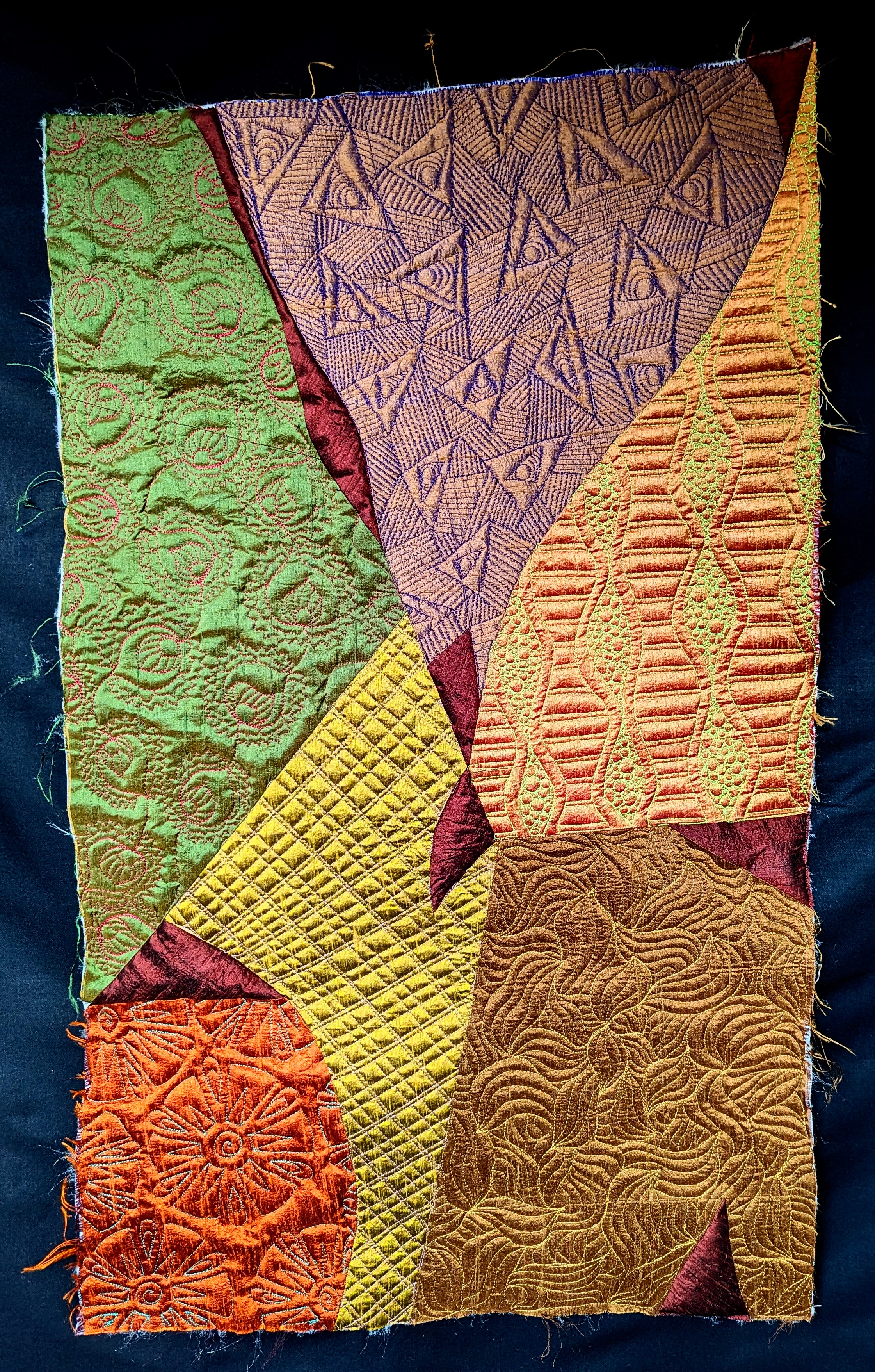
I’m also trying to be more intentional about my improv piecing, which again involves sketching first and then trying to make those sketches come to life with fabric and thread. The example below is the first of what I hope to make into a series called Patterns. I would ultimately like to create a library of these quilts from which I can draw FMQ motif inspiration for future projects.

And so my quilting journey continues. When I made my first quilt in 2017, I really didn’t see myself as a visual artist. I’m quite surprised at where this creative path is taking me, and I’m looking forward to whatever the future holds in store.

what are you afrAId of: Quiltmaking and Artificial Intelligence

Back in early 2024, all I was hearing about was generative AI and how it would change the world. There has been so much debate about whether the changes would be good, bad, beneficial, destructive, or all of the above. This debate has been quite intense in the art world, though maybe not so heavily discussed in the quilting world. Because of my day job as a transcriber, I have been well aware that technology will be replacing me at any point, but I had never really considered how it could affect my creative endeavors until I started seeing everyone’s experiments with image generators. I decided to find out for myself just how afraid or excited I should be about using this cutting-edge technology in combination with a millennia-old craft and art form.

The Brooklyn Quilters Guild had an outdoor fence show in the autumn of 2024 that was titled The Stories We Tell: Folklore, Fantasy, and Folly! I almost immediately had an image come to mind when I started thinking about quilt ideas for this show. I imagined a person staring into a cracked mirror. The reflection’s arm is reaching through the mirror holding some sort of object representing power. Kind of a “Snow White/Through the Looking Glass/Garden of Eden” type deal. The problem with this idea was that I do not have the artistic skills necessary to draw the kind of image I wanted to create, so what a perfect time to dip my toe into the world of generative AI, right?

I decided the best way to transfer what I was imagining into an actual quilt would be to use the raw-edge appliqué technique. Interestingly, this technique already takes advantage of quite a few forms of technology that weren’t available to quilters of yore. You generally use double-sided fusible interfacing if you’re creating a raw-edge appliqué design. Many folks use photographs as the foundation of their quilt images. Then you can use a printer or a projector to trace the portions of the photograph into the different sections you’ll eventually appliqué together. So why not add a little generative AI into the mix? It’s actually not that big of a leap when you really think about it.

Next, I had to choose a program to create the image. After a relatively quick Google search, I opted for Microsoft Image Creator (which is now called Microsoft Designer). I chose this program because it was free and offered unlimited prompts (I’m not sure if that’s still the case today).

I entered my first prompt:

gilt frame antique mirror with shattered glass reflecting the image of a person and a hand reaching out holding an apple

I proceeded to tweak the prompt 12 more times. I’ve posted all of the resulting images below.

My final prompt was:

in the style of an oil painting, a nonbinary person staring into a shattered gilt frame antique mirror set at an angle. A completely separate hand holding an apple coming out of the mirror

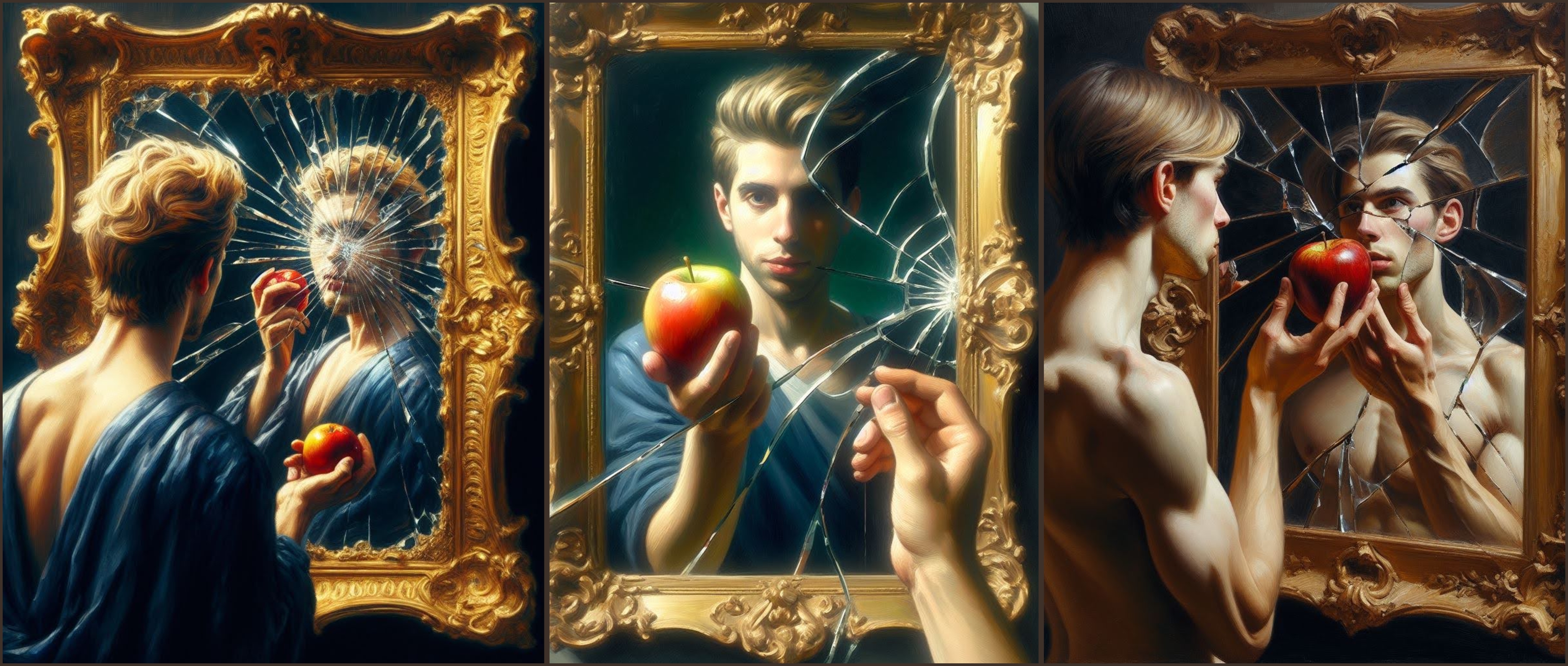
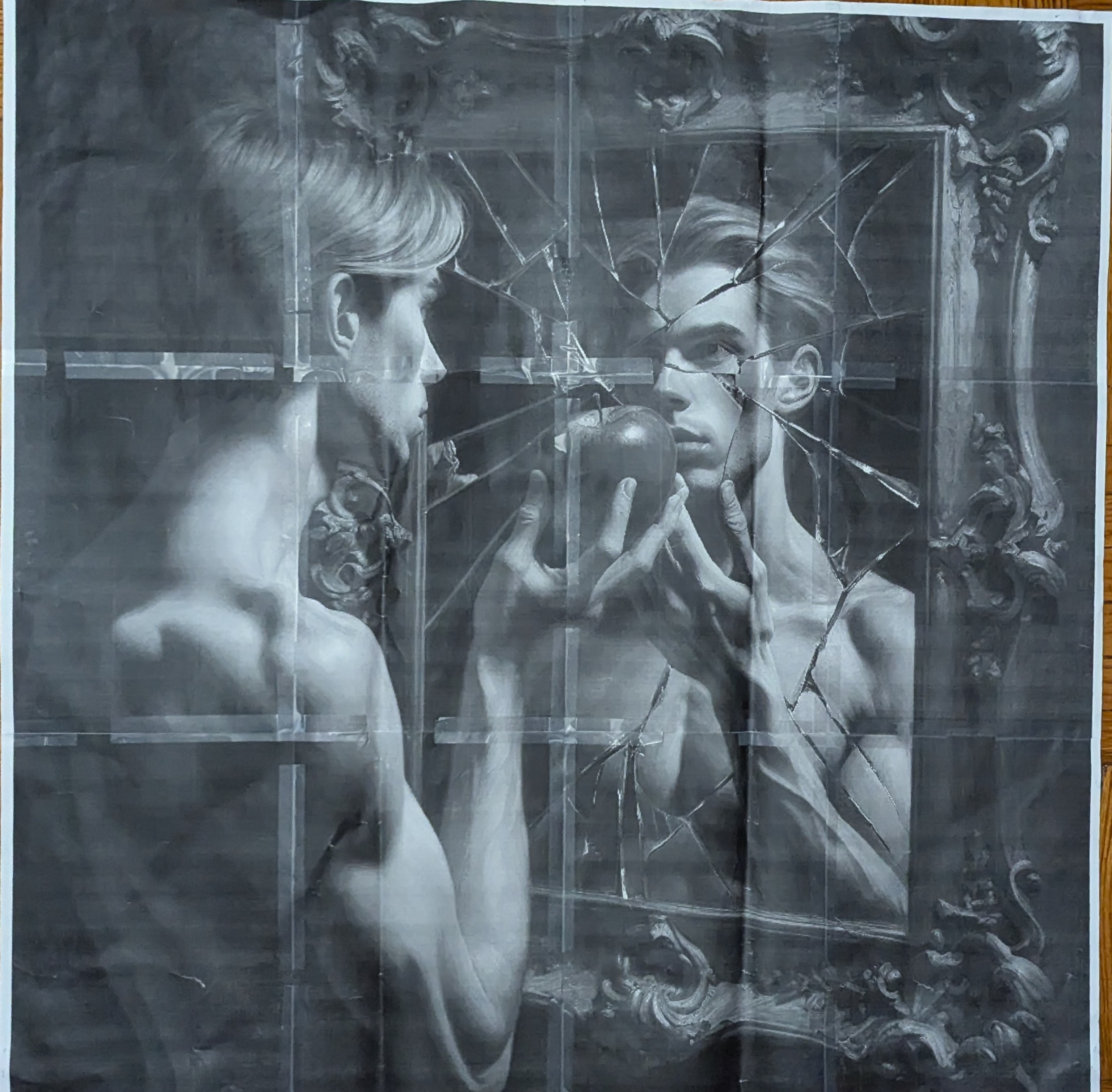
These were the three images that came closest to what I was picturing in my mind.

While none of these images were exactly what I wanted, I decided the one on the far right was close enough and I could make changes as I was putting it all together. You may also notice that all of the figures are holding an apple. I had no plans to use an apple as my symbol of power, but “flame-like blob of power” was a little too abstract for the image generator.

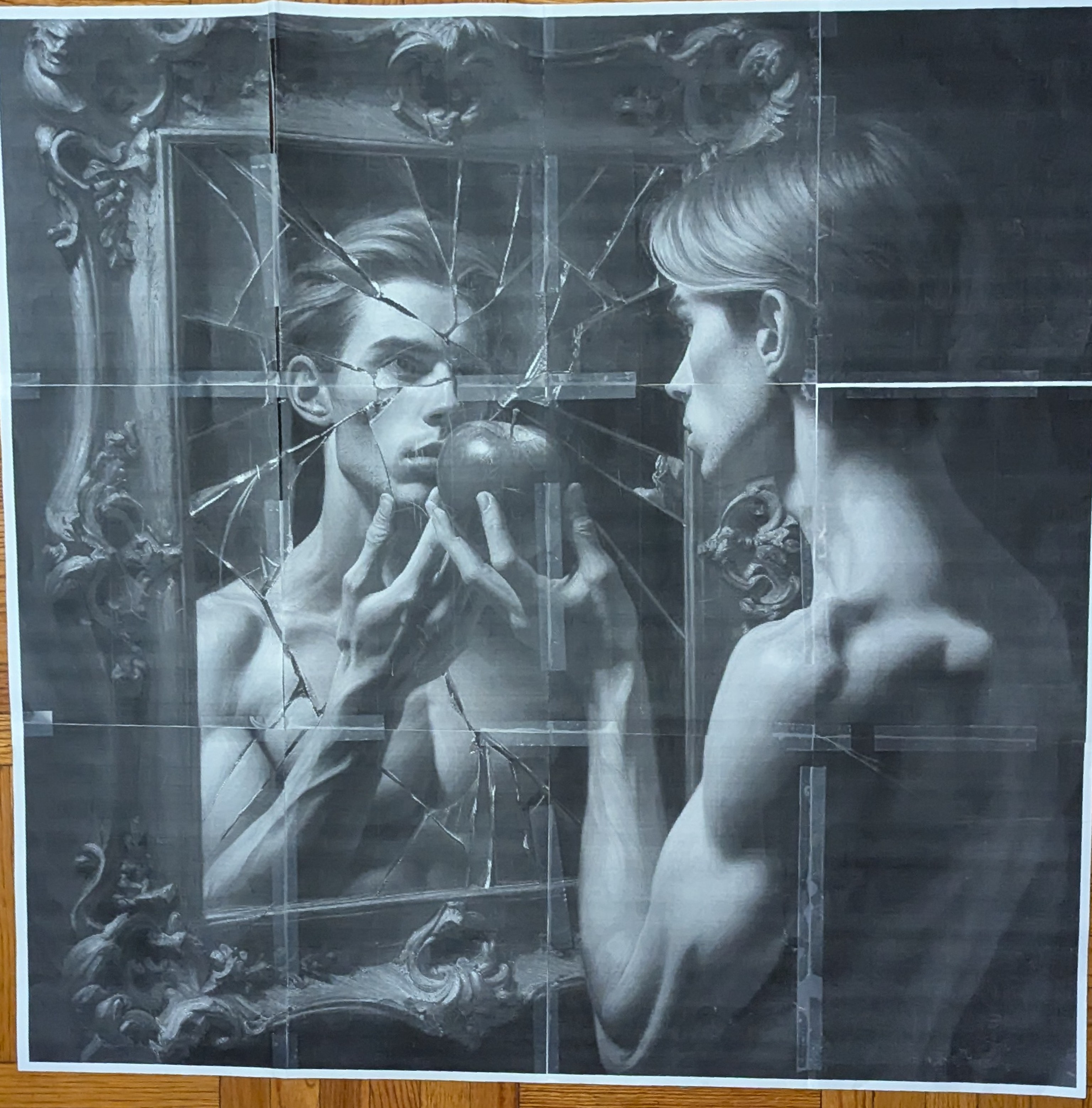
Once I chose my image, I used Blockposters.com to enlarge the image to the size I wanted and then printed it out on my black-and-white printer. And because I was using the raw-edge appliqué technique, I needed to mirror the image and print out that version as well since everything you trace on the back of your fused fabric will reverse once you start putting all the pieces together. I suppose I didn’t have to print out the non-mirror image, but I found it very useful to have the full-sized image on hand as a reference when I started putting all of my many bits of fabric together.

I won’t go into all the nitty-gritty details of how one creates a raw-edge appliqué quilt (there are tons of online videos/workshops/classes if you’re interested), but I will say this was by far the most ambitious raw-edge appliqué quilt I’ve ever attempted and it was exhausting. I don’t know how all y’all do it! Respect.

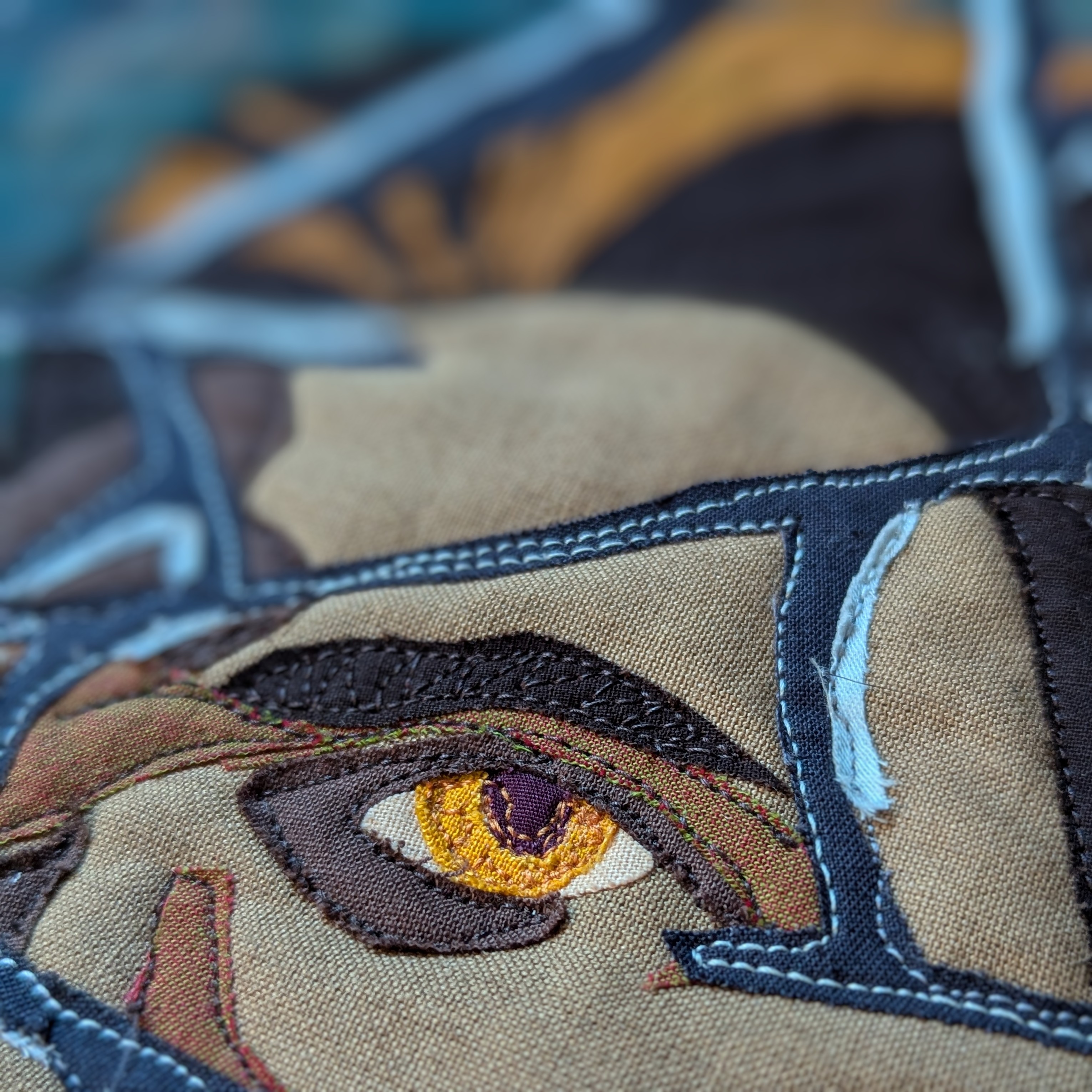
This is how my quilt turned out.

You can see that it looks fairly different from the final AI-generated image I chose. I intentionally tweaked the design as I was cutting the little bits of fabric out and deciding what details from the original image could be ignored and what details needed to be changed. While I can genuinely say the final product is my own design, I never could have gotten to this point if I hadn’t used the AI-powered image generator.

So after all of this, how do I feel about using AI in my making process? I’d say I’m pretty jazzed about it. For someone who has limited drawing skills, I am looking forward to experimenting further with AI image generators used as a tool to help me create more projects like this one. From an ethics point of view, I do believe one should be transparent about how AI was used in the process of creating a work of art, but I believe it can be used as a transformative technology to help create fascinating results.

BMQ YouTube Series – Ep. 21: Top Ten Tools

BLACK LIVES MATTER — Please click on the link to find out what you can do to help end the oppression and killing of our fellow human beings.

In this video, I show you some quilting tools that I kind of can’t live without. These are not the obvious ones like a sewing machine, rotary cutter, etc. These are tools that maybe you don’t absolutely need to make a beautiful quilt, but, man, do I find them super helpful! And rest assured I am not making any money in endorsements for these. (I mean, if someone wants to pay me for talking about their stuff, by all means, reach out. 😋) You can check out the links in the description section of the video to find out more about the items I discuss.

BMQ YouTube Series – Episode 9: Basic Sewing Machine Tips


BLACK LIVES MATTER
— Please click on the link to find out what you can do to help end the oppression and killing of our fellow human beings.

Since the COVID pandemic started in the US, there has been an uptick in sewing machine purchases so that people can sew face masks and keep themselves occupied while in lockdown. I thought it would be fun to just give a few very basic tips for people who are completely unfamiliar with sewing machines or haven’t yet gathered up the courage to use the one they bought at a garage sale 20 years ago.

I’d love to hear tips from all of you, so please share in the Comments section below. Please be sure to subscribe to my channel so you don’t miss any of my upcoming videos, and feel free to leave comments or questions below. Thanks for watching!

#BrooklynConnectedQAL – Piecing It All Together

It’s time for the next video tutorial for our virtual quilt-along, hosted by the Brooklyn Quilters’ Guild ! I hope you’ve all been busy making all of your blocks, and now it’s time to start putting them all together. How exciting!!

Please post pics of your progress on Instagram and Facebook and use the hashtag #BrooklynConnectedQAL. And be sure to follow that hashtag so you can see everyone else’s posts. Find the written pattern instructions on Barbara Danzi’s blog. Also be sure to subscribe to my YouTube channel so you don’t miss any of my upcoming demos. And please leave questions and comments and advice in the Comments section. This is all about staying connected as a community even as we’re staying home and social distancing.

#BrooklynConnectedQAL – Cutting & Piecing

Welcome to the next video tutorial for our virtual quilt-along, hosted by the Brooklyn Quilters’ Guild ! In this video, I’m demonstrating cutting and piecing the individual blocks for the quilt top. I include demos for ruler-cut blocks as well as improv-pieced blocks. Because it’s such a long video, I’ve listed the demo timings in the description box on my YouTube channel so you can skip ahead to the sections you want to watch.

Be sure to post pics on Instagram and Facebook and use the hashtag #BrooklynConnectedQAL. And follow that hashtag so you can see everyone else’s posts. Find the written pattern instructions on Barbara Danzi’s blog. Also be sure to subscribe to my YouTube channel so you don’t miss any of my upcoming demos. And please leave questions and comments and advice in the Comments section. This is all about staying connected as a community even as we’re staying home and social distancing.

BMQ YouTube Series: Episode 4 – Ryan

My latest YouTube video is up! I sit down with Ryan Migge and discuss his creative journey and what he does to get over those roadblocks that keep us from finishing our projects. As always, I’d love to hear from you, so please leave any comments or questions on my YouTube channel or contact me through my website. And be sure to subscribe to my YouTube channel so you don’t miss out on any of my upcoming interviews!

BMQ YouTube Series: Episode 01.5 – Shannon

Because I started my YouTube series with a different concept, I have posted the second half of my interview with Shannon Reed who learns to sew piping around an envelope-backed pillow. Check it out to see how it turns out, and please subscribe to my channel so you don’t miss out on any future videos!

Quilting 101: Resources

When I started my quilting journey back in March of 2017, I did what I always do whenever I have no idea where to start.  I Googled. I quickly found Craftsy.com (now mybluprint.com), and saw what a rich resource of all things crafting it was. Because I’m still somewhat new to the quilting world, I still use the Internet all the time to find out more about techniques and patterns, to shop, and just to get inspiration.  In this post, I’ve listed a bunch of resources that I use on a regular basis. I’m sure this list will continue to grow over the years, and I welcome any input you would like to see added. I’m always eager to learn as much as I can about all things quilting!

Quilting/sewing resources

YouTube — Go to youtube.com and search for the names listed below.  If you like the videos, be sure to click on the thumbs up icon and also Subscribe so you don’t miss out on any upcoming videos.  

Missouri Star Quilt Co. — Jenny Doan is an inspiration both as a quilter and a businesswoman.  She and her family have built a true quilting empire in Hamilton, Missouri, and I love how she is able to come up with easier ways to create traditional quilt blocks.  If you like working with precuts, this is definitely the channel for you!

Midnight Quilt Show — Angela Walters is the free-motion quilting queen!  She also has a great sense of humor, and I love her quilting philosophy of how finished is better than perfect.  I particularly like these videos because they’re short and very well produced.

Man Sewing — Rob Appell has A LOT of energy and enthusiasm for all things sewing, including quilts.  He gives great advice and offers a large range of different sewing techniques and projects.

Mr. Domestic — Mathew Boudreaux has an infectious joy that comes through in all of his video tutorials.  He also has incredible technique. If you’re looking to hone your skills and get ready to show your stuff for juried shows, you should definitely check out his videos.  

Fat Quarter Shop — Kimberly Jolly has created an amazing business with Fat Quarter Shop.  Not only is she a great retailer, but she produces so many informative videos on a regular basis that run the gamut of all things sewing.  She also has block-of-the-month clubs and other sew-alongs that help you feel like you’re part of a big quilting family.

MADE Everyday — Dana Willard’s YouTube channel has tons of very highly produced sewing tutorials.  Only a handful are quilting related, but this is the first channel I go to whenever I need to learn a technique such as sewing piping around a pillow or inserting zippers or making a vinyl bag, etc., etc., etc.  

Social Media — Before I started quilting, I was not that much into social media.  I originally joined Instagram as a way to chart my quilting progress, but I quickly discovered the enormous amounts of inspiration that can be gained from following all the amazing quilters through social media.  It’s a great way to become part of a worldwide community without leaving your sewing room.

Pinterest — This is the place to go when you just want to scroll through pretty pictures of whatever you’re interested in.  You can create your own folders and save the pictures as a reference whenever you need inspiration.

Instagram — I’m totally an Instagram convert!! I love following the many awe-inspiring quilters all over the world and seeing what they are producing every day.  It gives me motivation to keep producing my own work so I can show off what I have to offer, too.

Facebook — Facebook is a little trickier when it comes to following quilters because you have to request to be their friend unless their account is set up so that you can follow them.  However, pages can be set up on Facebook which you can join and share photos, thoughts, and compliments about whatever your group is focused on. When I was working on a mystery quilt challenge through National Quilters Circle, I joined their Facebook page, and it was such a great way to chart my own progress along with everyone else’s.  

MeetUp — This is a great app when you’re looking to actually meet people in real life.  Gasp! Yes, people actually still want to hang out in real life together these days.  I haven’t actually used MeetUp for anything quilting related … YET … but I have used it for other purposes and it’s been great.  If you’re having trouble finding a local quilters guild or a group of like-minded craft enthusiasts, I highly suggest you start your own MeetUp group and see who wants to join you.  

Local quilt shop/sewing/craft store — I’ve traveled all over the country, and it seems like there’s a quilt shop just about everywhere I’ve gone.  Not only do the people who run these shops have great knowledge to share with you as a customer, they also offer classes and bring in professional quilters for trunk shows and lectures.  I have yet to go to a quilt shop where the staff hasn’t been incredibly friendly and generous with their time.

Local/national quilters guild — When I realized I was actually a quilter I decided I needed to meet other quilters.  At some point I heard the term “quilters guild” and did an online search to see if there were any in my area.  Sure enough, there were several. I went to a Brooklyn Quilters Guild meeting and immediately joined. I’ve been a member since the fall of 2017, and it’s been so wonderful being part of a quilting community.  Not only do you get to share your love of quilts with like-minded people, but most guilds do a lot of charity work and that is good for the soul.

Websites/blogs — Sometimes I don’t necessarily want to sit through a YouTube video to learn a simple technique, so I just do a quick Google search for blogs.  A lot of these blogs are also retail sites, so you can do some shopping while you’re browsing online. If there’s a blog that speaks to you in particular, you should subscribe to their newsletter so you stay up to date with their regular posts.  

Local colleges — A lot of the local colleges offer classes for non-enrolled students.  I took a basic sewing class at the Fashion Institute of Technology several years ago that helped me get over my fear of my sewing machine.  Learning from an actual live person and having a structured curriculum worked really well for me.

Books/magazines — Honestly, I don’t really buy many craft books or magazines these days.  I pretty much find everything I need online. But there are still lots of amazing books and magazines being published today, so if you’re someone who loves filling their shelves with crafting books to show off to your visiting friends and families, go out and get some.  What I like most about crafting books is that the authors usually mix technique with their own personal stories. There are also great coffee table books out there if you just want to look at high-quality photos of pretty, pretty quilts.

Non-sewing resources

If you’re looking to step up your quilting/crafting game and go beyond following someone else’s pattern, I suggest you start thinking like an artist.  I’ve had the fortune to sit in on a lot of art classes over the last several years, and I’ve seen how much students grow and evolve over their college years because of technique and theory classes as well as structured critique from their professors and peers.  I’ve listed a few things to consider if you want to think outside the box. It can be so helpful to let ideas and techniques from other artforms influence your own work.

Color theory — As a crafter, you probably have a natural sense of color theory, but learning the science behind color can really boost your crafting game.  One of my favorite aspects of color theory is the idea of transparency. There are some really great guidelines out there if you want to create the optical illusion of overlapping colors in your quilts.  

Worqx.com — This website has TONS of color theory information at your fingertips.  I highly recommend taking a glance through it.

Interaction of Color by Josef Albers is the go-to color theory book most art students have to read in college.  These color theory principles serve as the foundation for your work with color.

Art history — Looking at what artists have been doing over the millennia is so inspiring.  As a quilter, I’m not looking to mimic any artist or their work, but I love seeing what they do in their own medium and thinking about how I could maybe apply one or two elements into my own work.  

Other creative arts — There is inspiration to be found everywhere!  This is just a tiny list of areas that might spark an idea in your own process.  

  • Photography
  • Painting
  • Drawing/illustration
  • Commercial design
  • Architecture
  • Textiles and patterns