Quilting Process: Behold My Beauty and Weep

I just finished a quilt and figured I might as well blog about the process I went through to create it. Please feel free to reach out with any questions!

I belong to the Brooklyn Quilters Guild and ever since the COVID pandemic, we’ve been holding small outdoor quilt shows where we hang our quilts on the rod-iron fence that surrounds the block where we have our monthly meetings. Check out our YouTube channel to see videos of our past fence shows!

We will be having our next fence show sometime in the early fall of 2024, and the theme is The Stories We Tell: Folktales, Fantasy & Folly. I was very excited when I heard the theme because I am a huge fantasy/sci-fi fan. I immediately started thinking of whole-cloth quilt ideas with images of dragons and other mythical creatures floating in my mind. However, my drawing skills are still fairly rudimentary, and I quickly realized my ability to free-motion quilt a dragon isn’t quite there yet. So then I thought about a quilt I made in 2023 for a different guild challenge which is pictured below. The idea behind that quilt was a scaled and feathered creature staring out at the viewer.

Green fabric that has been heavily quilted to look like a large eye staring through feathers.

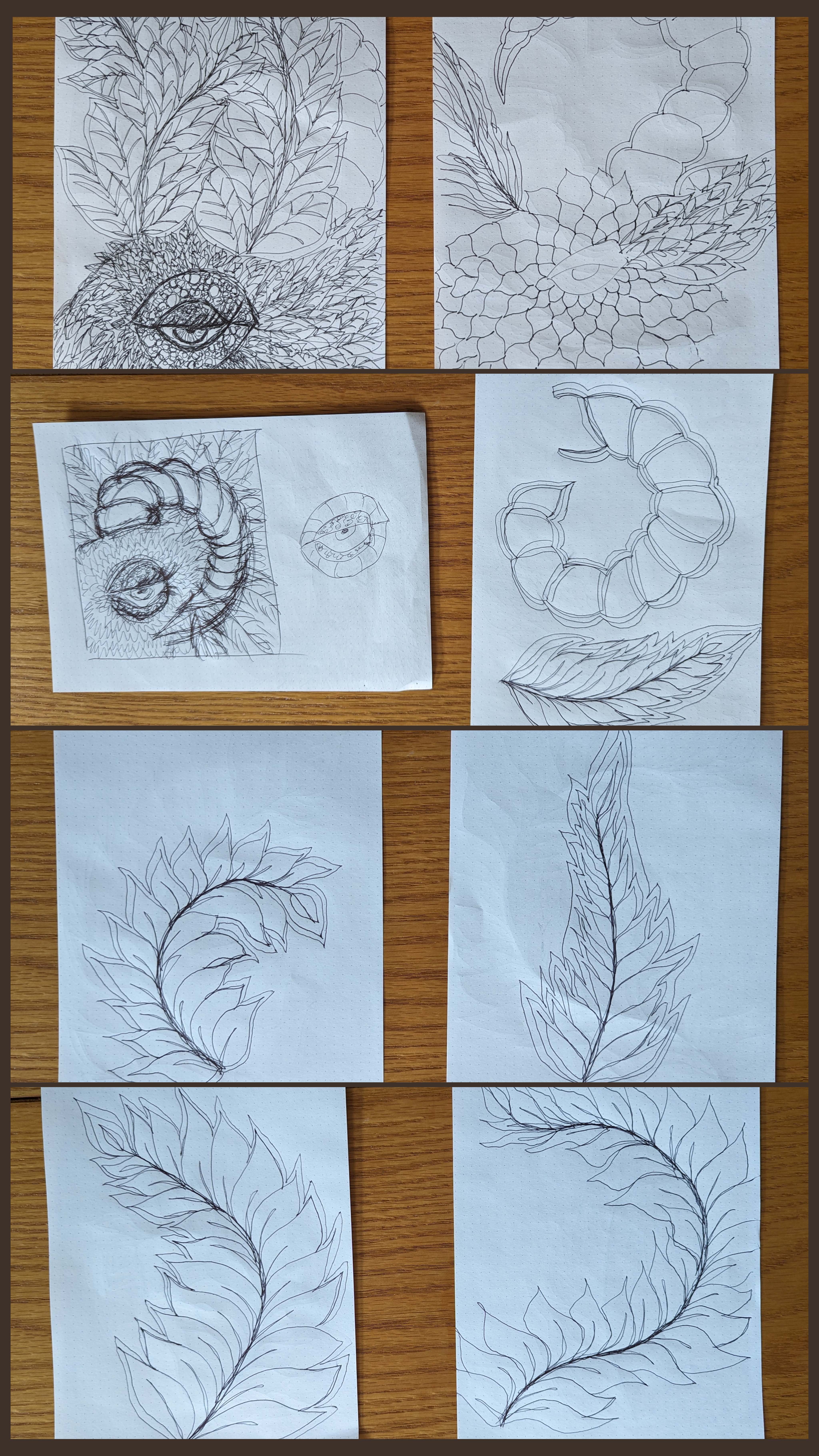
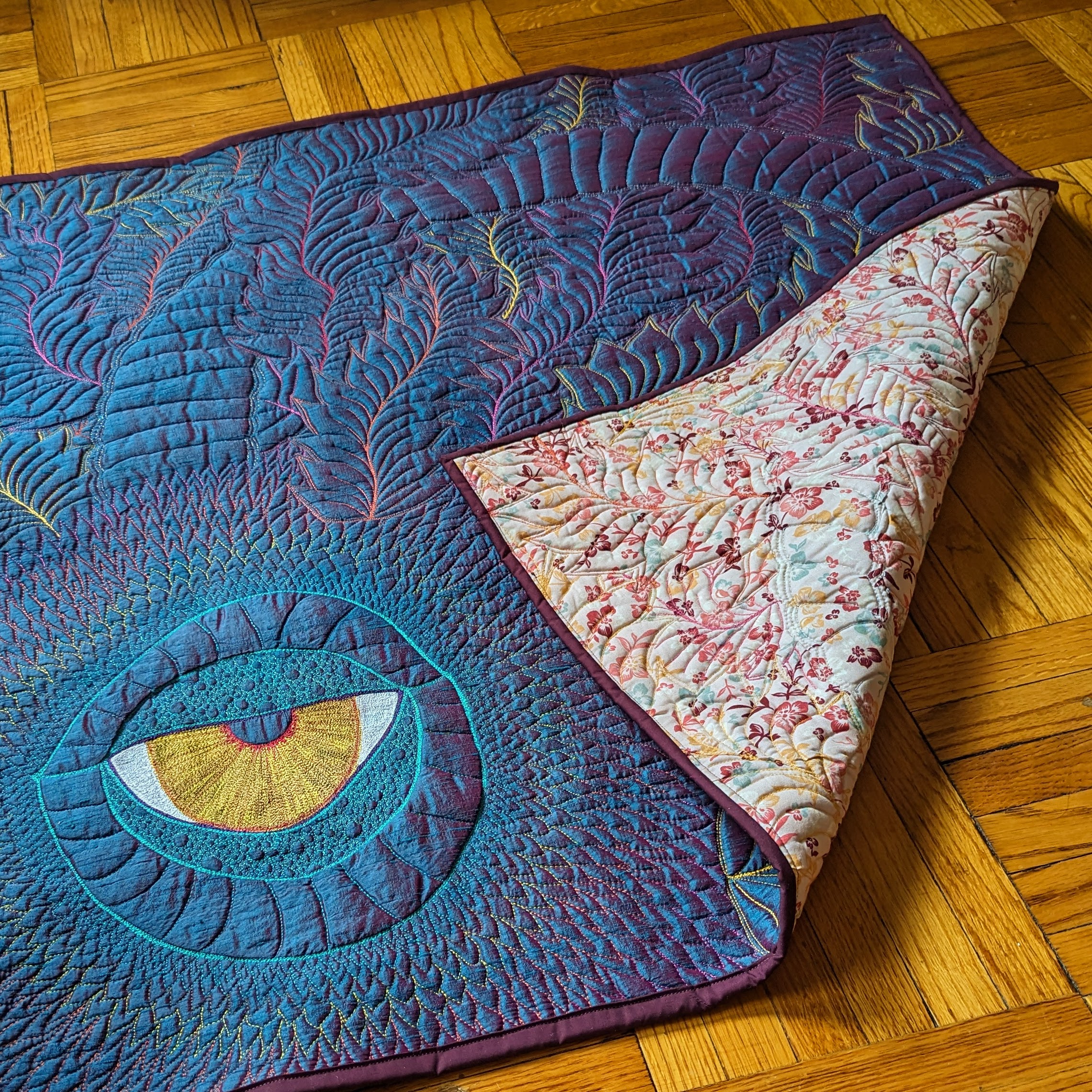
I had also purchased two yards of beautiful raw silk from a quilt show in the fall of 2023. I knew that was the fabric I wanted to use along with some pools of polyester thread that would shine beautifully on the finished quilt. I love free-motion quilting feathers, so I decided to do an online search for images of “feathered dragons.” The images that came up right away were Quetzalcoatl, the Mesoamerican mythological figure that is often referred to as a feathered serpent that flew through the air and provided rain for crops, among many other abilities. Using those images as my starting point, I started sketching out ideas with pen and paper until I was ready to work with my actual fabric.
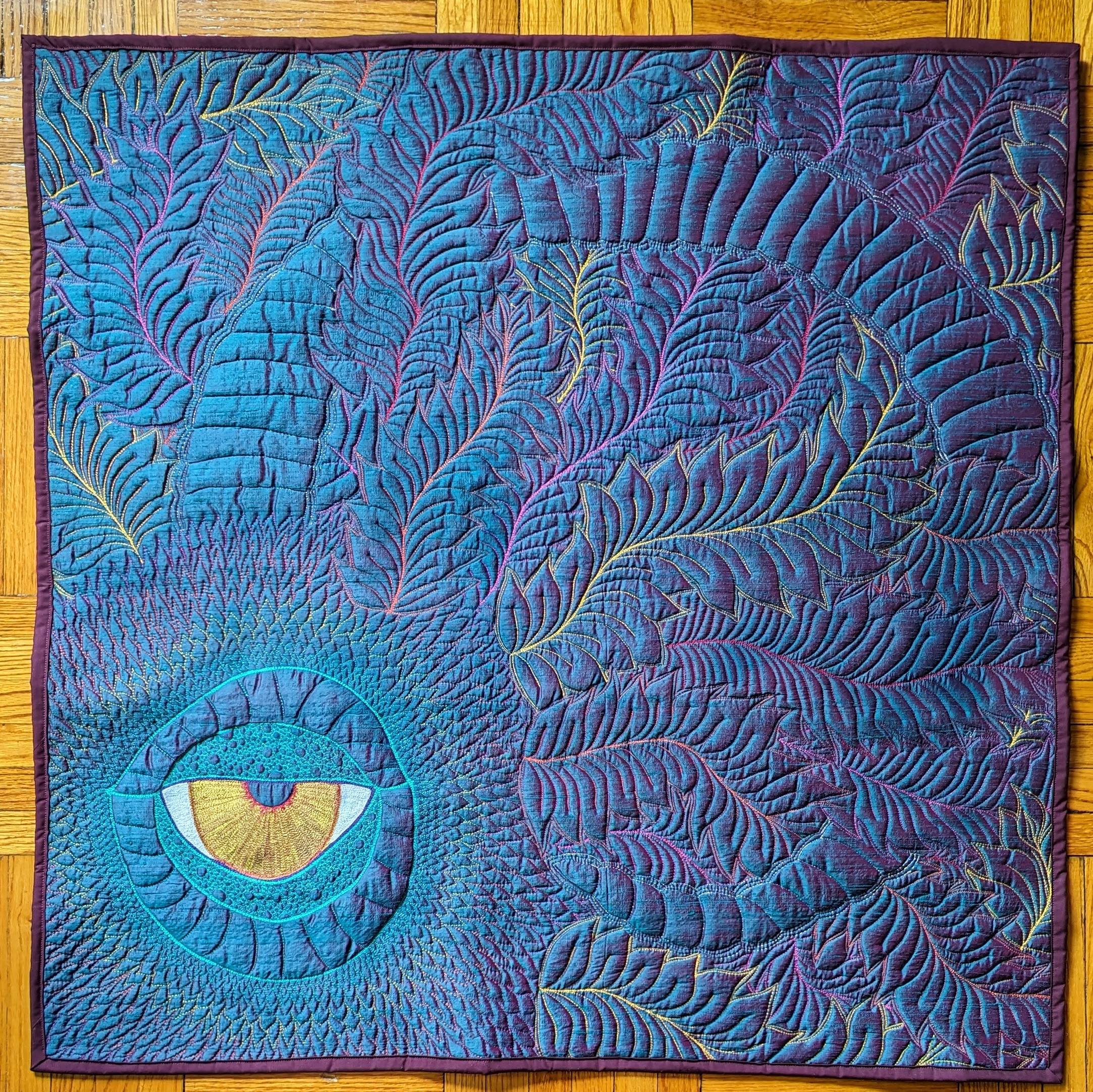
I pin basted the gorgeous raw silk together with a very high-loft batting and my cotton print backing fabric. Then I took small pieces of all three layers and tested out the different colors of polyester thread that I thought about using to see what colors would work best. I quickly saw that the green and purple threads didn’t stand out enough for the overall design I had in mind. I loved how the warmer colors worked, so I decided the feathers were going to be red, pink, orange, and yellow. And because the raw silk generally looks blue (though sometimes magenta depending on the angle and lighting), I knew I wanted the large eye to contrast so I decided to make a yellow-orange eye with red highlights.

Once I had made those design decisions, I began the actual thread painting and quilting. I used the same general process as I did with my O, beware . . . quilt. I started by thread painting the eye. I layered several different colors of thread on top of each other to create the iris of the eye, which gives depth and plays with the light beautifully, much more so than if I had just used a single thread color. Once the eye was finished, I used silver metallic thread to create the horn (which is not a feature of the typical Quetzalcoatl images you typically see).
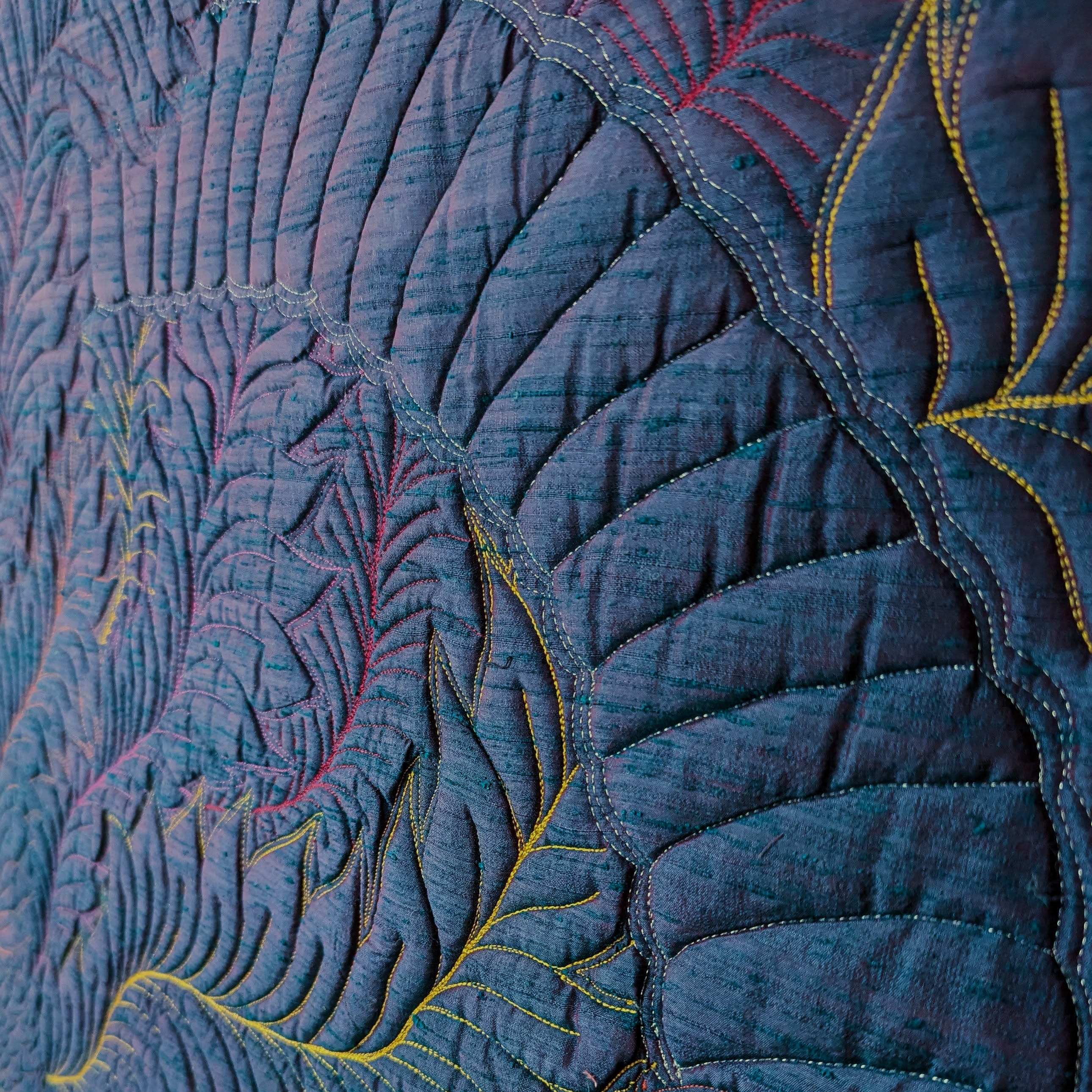
I didn’t love the overall look of the horn, but I decided to start working on the feathers and see if that would change how I felt. After I quilted the first couple of feathers, I realized I needed to pick out two sections of the horn and quilt some feathers in front of it while the rest stayed behind it. I hate picking out quilting threads and usually avoid it at all costs, but I knew this would make a huge positive difference. And it turns out I was 100% correct. I was much happier with the overall design of the quilt once I had some feathers quilted on both sides of the horn.

Once the whole thing was quilted, I needed to block my quilt. I set up my ironing board with my full-length wool pressing pad, turned the quilt backside up, drenched a tea towel with water, wrung it out, and then ironed the back of the quilt in sections with the wet towel in between. This is a blocking process I used when I crocheted a sweater several months ago, and it works really well. I then hung the quilt from my photo stand and used rubber covered clamps to stretch the quilt out from the top and bottom corners. In the future, I need to figure out a way to attach clamps on all four sides so that the quilt will dry perfectly flat. But this time I did what I was able to do, and the quilt dried pretty flat.

The quilt needed to finish at 36″ x 36″, but I intentionally created a larger piece because such dense thread painting and free-motion quilting will shrink the overall quilt size quite a bit. I still ended up having to cut off about two inches of fabric from both sides when I squared it all off, but I think that tightened up the overall composition of the piece which was nice.

And then I made a totally rookie mistake with the binding. I was halfway around the quilt when I realized I had started machine sewing the binding on the back of the quilt rather than the front. Normally, I like to machine sew the binding to the front of the quilt and then hand sew the rest of the binding to the back of the quilt. Since I was already halfway around, I decided I was going to use this mistake as an opportunity to practice my machine binding. So I went ahead and sewed the entire binding with my machine. And wouldn’t you know it, the more often you practice something, the better you get! My machine binding is starting to look pretty good these days. And it sure saved me TONS of time! So that’s the whole process for how this quilt came into existence. Reach out with any questions and thanks so much for going on this journey with me.
Creating a Quilt: Part 1 – Inspiration and Ideation

The Brooklyn Quilters Guild 2020 quilt show is coming up, and I finally came up with an idea for the quilt I want to make for it. My friend Shannon Reed (@knittingchick on Instagram and @sreed151 on Twitter) suggested I use this as an opportunity to post my process from the very beginning to the very end of the quilt’s journey. I thought that was such a great idea, so here we go! Thanks, Shannon!

When I’m trying to think up a completely new quilt, the first thing I do is look for inspiration. Sometimes the inspiration is given to me by a prompt for a quilt challenge or contest. Sometimes — VERY rarely — the idea just pops into my head fully formed and my finished product looks exactly like what I pictured in my head from the very beginning. This happens very rarely for me. In fact, it’s maybe happened one time so far. Generally, I’m a big fan of prompts and parameters.

In this case, however, my inspiration came in a roundabout way and I just allowed my brain to take that curvy path to what I think will be a pretty cool quilt. I’ve been looking at all the beautiful quilt blocks people have been posting on Instagram for the Tula Pink #100blocksin100days challenge inspired by her City Sampler book, which happens around this time every year. And then I was chatting on my Facebook page with Johnny Barfuss (@johnnybarfuss on Instagram) who had suggested I take a look at Elizabeth Hartman‘s book Patchwork City, and I mentioned I had been thinking about designing my own blocks. Like all good quilters, Johnny was very encouraging. So I started doodling some blocks in my sketchbook without any ultimate goal in mind.

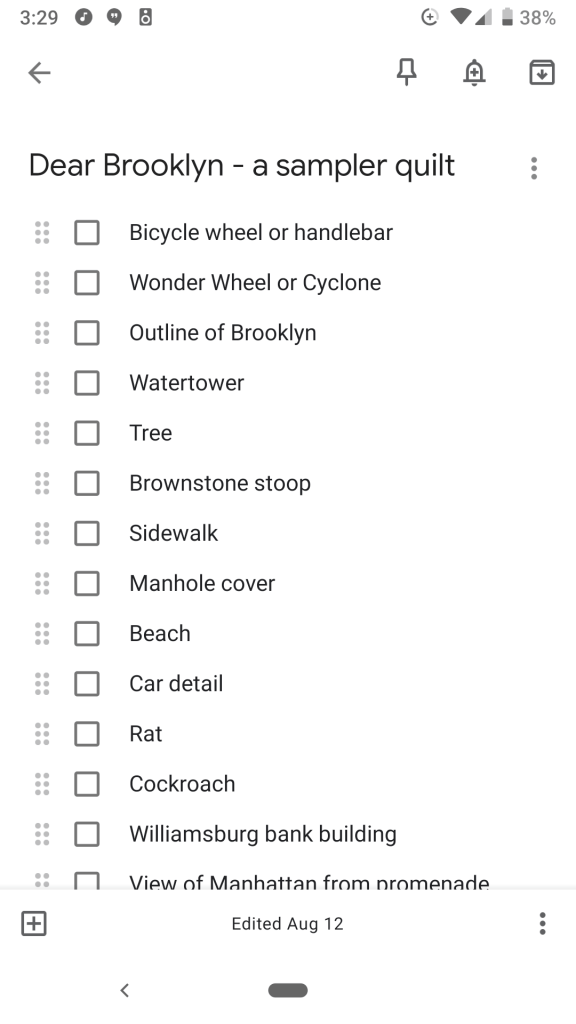
When I looked into Elizabeth Hartman’s book, I read how her blocks were inspired by objects and places in her daily life, and — boom! — that was when inspiration struck. Eureka! I realized I could combine this desire to design some new blocks with my desire to create an original quilt for the upcoming quilt show. I would sketch out a bunch of images that pop in my head when I think specifically of Brooklyn. Then I would make those into a series of blocks and create a Dear Brooklyn sampler quilt, as an homage to the Dear Jane quilts that I ogle every time I go to a quilt show.

My first step was listing all of the ideas I could think of for my quilt blocks. At this point I wasn’t thinking about what would make a good block and what would be impossible. I just let the ideas flow and kept the list going. This is the beginning of the ideation phase (just in case that’s a new concept for you). In the design world, the ideation phase generally involves a whiteboard and hundreds of Post-its. My version involves my smartphone’s Google Keep app and a sketchbook.

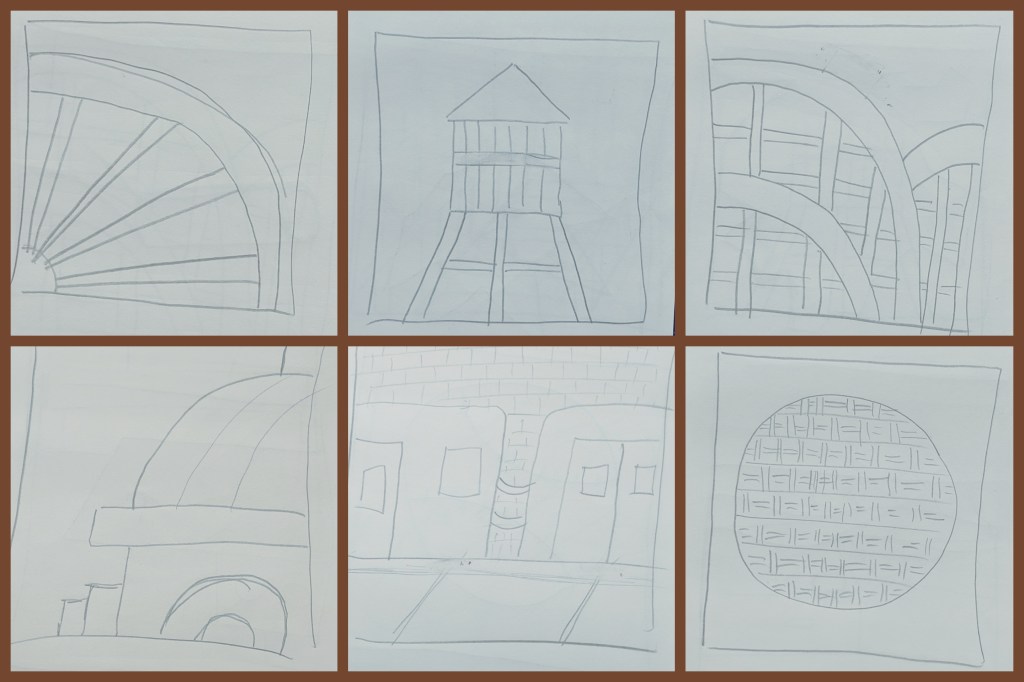
Once I had a good-sized list, I started sketching the ideas out. My sketches varied between abstract and realistic because I hadn’t decided yet what direction I ultimately wanted to take my quilt. I think it’s important at this very early stage of the creative process that you don’t put too many limitations on yourself. Editing will come later and is necessary for the final product, but right now just allow yourself to create anything and everything that comes to mind. You never know — one of those absurd, impossible ideas might end up being what works the best.

I started looking over the several sketches I had drawn and decided I wanted my quilt blocks to lean more towards abstraction versus realism. In fact, right now I’m thinking I want them to be so abstract that someone looking at my quilt won’t even necessarily know the reference material for each of the blocks. So I started making thumbnail sketches of the more realistic blocks, focusing on a small section of the overall sketch. As the creator of the quilt, I want to be able to look at the blocks and know exactly what inspired them, so I don’t necessarily want the blocks to be super abstract. But on the other hand, I’m not so concerned that anyone else looking at the quilt will be able to instantly see the source material for each block. In other words, I’ll know that block with a series of curves was inspired by a cockroach, but a random viewer of my quilt would probably never guess that’s how the block came about.

And that’s where I’m at so far. I still have a lot of sketching to do for most of my ideas. The next phase will be playing with scraps of fabric to see how the blocks work in reality and not just on paper, so you can look forward to seeing how that turns out in the next post about this process. I’d love to hear about how you find inspiration in your quilting and other craft projects. Do you prefer parameters when you’re creating? Or are you someone who can some up with ideas completely out of the blue? Please share in the comments section below, and let’s get a conversation started. Happy quilting!

The Craft of Quilting: Process

Many moons ago, I earned a degree in Musical Theater. Tra-la-la!! As I was learning how to sing to the balcony without ripping out my vocal cords and how to form the perfect pair of Fosse jazz hands, I also learned about the difference between art and craft. The art of acting — or painting or playing the violin or dance, etc. — is not easily defined and can be associated with vaguely defined terms like “talent” or “the it factor.” The ability to tap into that mysterious inner fire of creation is essential to any artist. But equally essential is the development of one’s craft in conjunction with their art. Yes, to be a successful actor, you need to have that inherent ability to capture the attention of a 1,500-seat theater full of people and bring them with you on your character’s journey. But being able to successfully do that eight performances a week, 50 weeks a year requires craft.

Now, I have to admit that when I first started quilting, I didn’t think too much about any of this. I mean, sure, I was learning techniques and trying to improve each time I pieced a block together, which is part of honing one’s craft. But as long as I was following someone else’s instructions to achieve their design, the idea of process never really crossed my mind. In fact, it wasn’t until my third original quilt that I realized I couldn’t wing my way through designs that were percolating in my head and just expect them to appear fully formed under my sewing machine.

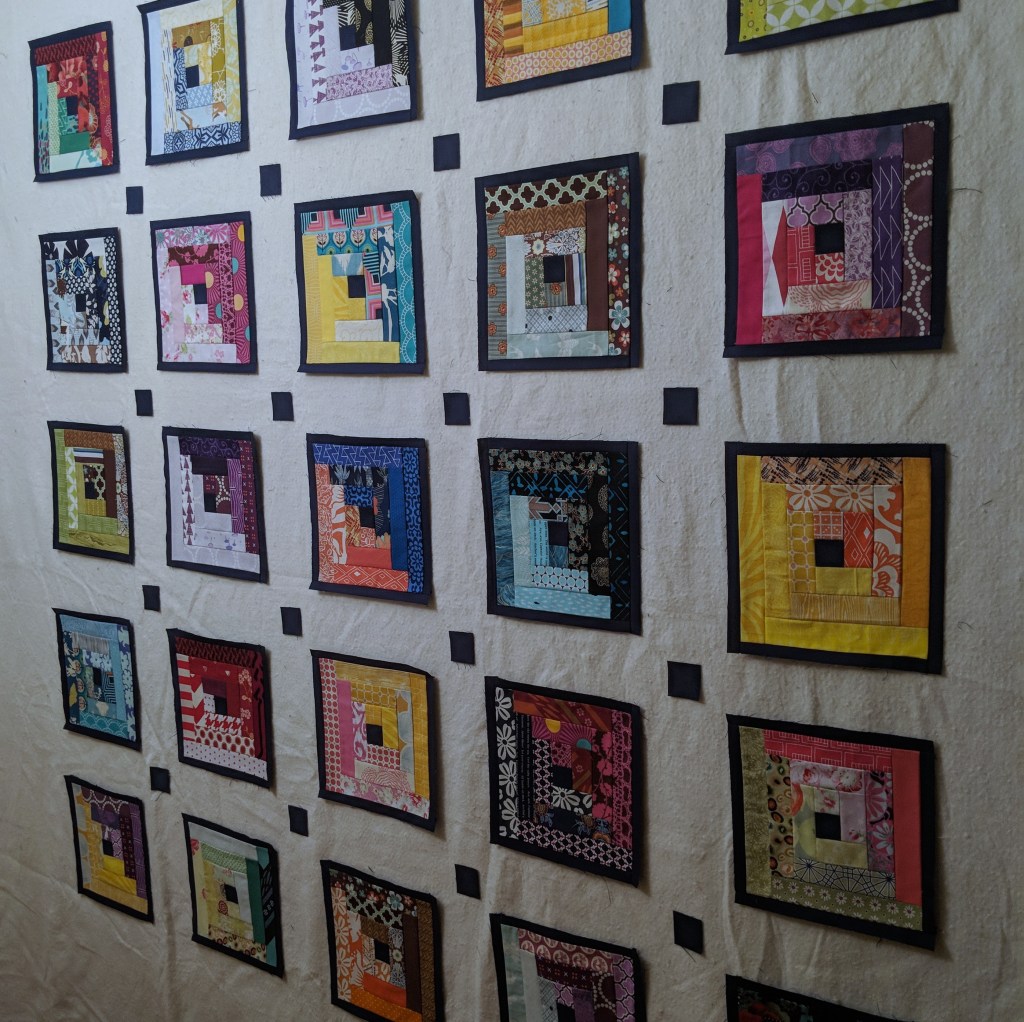
You see, I had decided to create a quilt as a housewarming gift for a very dear friend. Because she is a fellow crafter, I knew she would have no problem with me experimenting a bit with my scrap bin to make something fun. I decided I would make a bunch of Log Cabin blocks using a somewhat random selection of scraps and just kind of figure out the rest as I went along. After I made about 11 or 12 blocks, I decided to slap them up on my design wall to see what order I wanted to put them in, and I was horrified by the result. They looked horrible together!! It didn’t matter what order I put them in. They all completely clashed with each other, and I had a fit because I had spent so much time making all of them.

After I managed to calm down, I stood and stared at the blocks for a very long time. I mean, like, a really long time. (One of the things I’ve learned about myself over the years is that I am not a quick thinker.) I gave myself permission to just stand and stare and let my creative juices do some behind-the-scenes work in my brain.

I eventually came up with a couple solutions. One, I would use sashing to put some much needed space between each of the blocks. Two, I would frame each block with the same navy blue I had used for the center square of each Log Cabin. Once I tried that on a few of the blocks and put them back up on the design wall, I realized it was actually going to look amazing!

This was a big epiphany for me. I thought, Oh, yeah! This whole designing-a-quilt-thing is actually a process! Sometimes ideas work, sometimes they don’t. Sometimes they don’t work until you try something two or three or four more times. And that’s great because it means you’re thinking like an artist! No one creates perfect pieces of art out of thin air no matter how brilliant they are. You have to ponder, sketch, workshop, rehearse, change your direction, think outside the box, and all of that good stuff before you actually achieve your vision.

Now I want to offer a few suggestions specific to quilters who want to start working on their process.

  • Sketch out your ideas or use a program to help you sketch out your ideas
  • Get a design wall
  • Make test blocks using fabric you don’t care about
  • Don’t get frustrated when your test blocks don’t automatically come out how you wanted them to; use it as an opportunity to discover the changes you want to make
  • While it’s always great to stretch yourself and try new skills, don’t feel guilty if you decide you just don’t like certain techniques; embrace your strengths
  • Take an art class that has nothing to do with quilting and learn about composition, form, line, color theory, and all that good stuff that can elevate your quilt designs to a new level
  • Take photos throughout the process of your quilt so you have an archive of how you overcame past challenges
  • Don’t be afraid to ask others to look at what you’re making if you find yourself stuck, though be aware that some people do not know how to give a helpful critique (I should probably write a post about how to participate in a critique)

I’m sure if I sat here for another few hours, I could come up with many more suggestions, but I’ll stop here for now. Instead, I would now love to hear all about your process! Please leave a comment and share how your process works, so we can all help each other continue progressing through our exciting quilting journeys!